MDF vs Melamine Board: A Buyer's Guide for Furniture Manufacturers
Category: Product Knowledge & Selection Guides Primary Keywords: MDF vs melamine board; furniture-grade MDF; melamine faced chipboard

Introduction: Why This Comparison Gets Confused So Often
Ask ten furniture buyers to explain the difference between MDF and melamine board, and at least a few will describe them as two competing raw materials - as if choosing between them were like choosing between steel and aluminum. That framing is off. MDF is a core material. Melamine board, more precisely called melamine faced chipboard (MFC), is a finished product - a core panel (often particleboard, sometimes MDF itself) wrapped in a melamine-impregnated decorative layer.
This mix-up matters in procurement. Buyers who ask a supplier for "melamine or MDF, whichever is cheaper" are really asking two different questions at once: what's inside the panel, and what's on the surface. Getting this distinction right before you request quotes saves rounds of back-and-forth with your supplier and prevents ordering the wrong product for cabinet carcasses, furniture panels, or flat-pack components.
This guide walks through what MDF actually is, how melamine-faced boards are constructed, where the two genuinely compete (and where they don't), the formaldehyde compliance standards furniture exporters need to check, how to pick the right thickness for different furniture parts, and what to look for when qualifying a bulk supplier.
What Is MDF? Composition, Density Grades and Standards
MDF - medium-density fiberboard - is manufactured by breaking down wood residuals into fine fibers, blending them with resin, and hot-pressing the mixture into flat panels. Unlike plywood, there's no visible grain or layering; unlike particleboard, the fiber particles are far finer, giving MDF a smooth, uniform edge that machines and finishes cleanly.
Density is the number that actually defines an MDF grade, and it's where a lot of buyers get lost in marketing language rather than specifications. In North America, the ANSI A208.2 standard classifies MDF by physical and mechanical properties, with common furniture-grade panels falling in the 690–850 kg/m³ range depending on the specific grade (Duroboil - MDF Board Sizes Guide). Other technical sources put the broader MDF density spectrum at 500–1,000 kg/m³, with standard furniture MDF typically sitting between 600–800 kg/m³ (Marlite - What Is MDF Wood?).
In Europe, the relevant standard is EN 622-5, which governs dry-process fiberboards and defines two moisture-resistance grades specifically: MDF.H for general use in humid conditions, and MDF.HLS for load-bearing applications in humid environments (European Panel Federation - MDF Specialty Grades). If your furniture line includes bathroom vanities, kitchen cabinets, or any application near moisture, asking whether a supplier's MDF meets EN 622-5 (or the North American moisture- resistant equivalent) is a more useful question than simply asking for "good quality MDF."
Density directly affects performance that matters to furniture makers: screw-holding strength, edge routing quality, and resistance to sagging under load all improve as density increases, at the cost of weight and, usually, price.

A close-up view of MDF's fine, uniform wood-fiber structure - the density of this core is what determines screw-holding strength and edge finishing quality.
Melamine Board, Explained Properly
Here's the part that trips people up: "melamine board" isn't a core material at all - it's a construction method. A melamine- faced board takes a core panel (commonly particleboard, though MDF cores are also used for higher-end applications) and bonds decorative paper impregnated with melamine resin onto both faces under heat and pressure. The result is Melamine Faced Chipboard (MFC), a panel with a hard, scratch- and stain-resistant surface that mimics wood grain, solid colors, or textured finishes without the cost of real wood veneer (FurnBoard - What is Melamine Faced Chipboard?).
Two things follow from this. First, "melamine board" quality depends heavily on what's underneath the surface - a melamine face on a low-density particleboard core behaves very differently under load than a melamine face on a denser MDF core, even though both would technically be marketed as "melamine board." Second, when a customer asks "should I use MDF or melamine board," the more precise question is usually "should I use raw MDF that I finish myself, or a pre-laminated melamine panel that arrives finish-ready" - because a melamine-faced MDF panel is a real, commonly available product that combines both.
This is worth clarifying with any supplier quote you receive: ask specifically what core material sits underneath the melamine face, not just what the surface finish looks like.
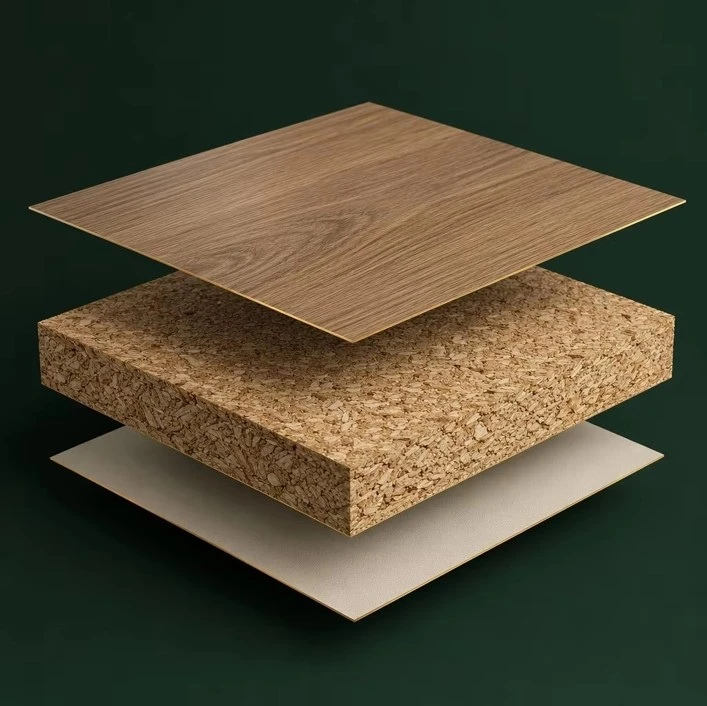
The three-layer construction of melamine faced chipboard (MFC): a decorative melamine resin surface bonded over a particleboard (or MDF) core, with a melamine backing layer beneath.
MDF vs Melamine Board: A Side-by-Side Comparison
|
Attribute |
Standard MDF (unfinished) |
Melamine Faced Board (MFC, particleboard core) |
|
Core material |
Wood fiber + resin, hot-pressed |
Wood chips/particles + resin (or MDF core for premium lines) |
|
Typical density |
600–850 kg/m³ |
Lower core density (particleboard base), surface hardness added by melamine layer |
|
Surface |
Smooth, unfinished - requires paint, veneer, or laminate |
Pre-finished, ready to use out of the box |
|
Screw-holding strength |
Generally stronger due to finer, denser fiber structure (Tribesigns - Particle Board vs MDF) |
Depends on core; particleboard cores hold screws less securely than MDF cores |
|
Edge finishing |
Machines cleanly, ideal for routed/profiled edges and paint-grade parts |
Requires edge banding to cover exposed core at cut edges |
|
Moisture resistance |
Standard grade absorbs moisture; MR/HMR grades available |
Surface resists moisture; exposed/cut edges remain vulnerable unless sealed |
|
Best for |
Painted furniture fronts, molded/profiled components, veneered panels |
Cabinet carcasses, shelving, flat-pack furniture, RTA components |
|
Lead time to finished part |
Longer - requires downstream finishing |
Shorter - arrives ready for assembly |
The practical takeaway: this isn't really an "either/or" decision for most furniture manufacturers - it's a matter of matching the material to the part. Manufacturers producing painted or profiled furniture fronts typically buy raw MDF and finish it in-house. Manufacturers producing cabinet boxes, flat-pack shelving units, or RTA (ready-to-assemble) furniture usually buy pre- laminated melamine board precisely to skip the finishing step and reduce production time per unit.
Formaldehyde Compliance: A Step Buyers Often Skip Until It's a Problem
Both MDF and melamine-faced particleboard use formaldehyde-based resins in manufacturing, which means formaldehyde emission standards apply to both - and compliance requirements differ by destination market, which matters enormously for exporters shipping to multiple regions.
In the United States, TSCA Title VI, enforced by the EPA, sets formaldehyde emission limits for composite wood products, and CARB (California Air Resources Board) Phase 2 standards are recognized as compliant when panels carry proper certification labeling (Decorative Hardwoods Association - Formaldehyde Standards). Notably, the EPA proposed updates to modernize the TSCA Title VI rule in February 2026, aligning testing methodology and adding quality assurance provisions - a signal that regulatory scrutiny in this space continues to tighten rather than relax (Federal Register - Voluntary Consensus Standards Update, Feb 2026).
In Europe and much of Asia, the common reference points are the E1 and E0 emission classes: E1-grade panels are generally limited to formaldehyde emissions around 0.124 mg/m³ under standard test conditions, while E0 represents a stricter, lower- emission tier increasingly requested by environmentally conscious retailers and public procurement buyers (Sumec Building Material - Plywood Formaldehyde Emission Standards).
For furniture exporters, the practical rule is simple but frequently overlooked: don't assume a formaldehyde certification for one market automatically satisfies another. A supplier's MDF might be fully CARB P2 compliant for the US market but not independently tested against E1/E0 thresholds for an EU order - or vice versa. Ask suppliers for the specific certificate matching your destination market, not a general "eco-friendly" claim.
Picking the Right Thickness for the Job
Thickness selection is one of those decisions that seems minor until the wrong choice shows up as sagging shelves or split screw joints six months after delivery. Here's a rough field guide based on common furniture applications:
 3–6 mm - cabinet backs, drawer bottoms, and other non-structural panels where weight reduction matters more than load capacity.
 9–12 mm - mid-weight components such as shutters, decorative panels, and lighter shelving.
 15–18 mm - the workhorse range for kitchen cabinet carcasses, doors, and standard furniture panels; most industry guides converge on 18 mm as the default balance of strength, weight, and cost for general cabinetry (Chanta Wood - MDF Thickness Guide).
 18–25 mm - base cabinets, bed frames, and other load-bearing furniture components that need to resist sagging over years of use.
 25 mm and above - heavy-duty structural furniture parts, worktops, and countertop substrates.
Melamine-faced particleboard follows a broadly similar thickness logic, with common furniture-production thicknesses concentrated around 16 mm, 18 mm, 25 mm, and 38 mm depending on whether the part is a cabinet side panel, a worktop, or a structural shelf (Liyuan Plywood - Melamine Board Thickness Guide).
One question worth asking your supplier directly during sourcing: does their standard thickness tolerance meet your production line's tolerances for automated edge-banding equipment? Thickness variance that's invisible to the eye can still jam high-speed edge-banding machinery on a production floor.

Panel thickness should be matched to the load and application - from thin 3–6 mm backing panels to 25 mm+ structural components.
Cost, MOQ, and What Bulk Buyers Should Negotiate
Pricing between raw MDF and melamine-faced board isn't a simple "one is always cheaper" comparison - it depends on what you're comparing it to on your own production line. Raw MDF typically costs less per panel, but that number doesn't include your own labor, paint, or laminate costs downstream. Pre-finished melamine board costs more per panel upfront but often reduces total per-unit cost once you factor in skipped finishing steps, especially for manufacturers running high-volume flat- pack or RTA lines.
A few negotiation points worth raising directly with suppliers rather than assuming standard terms:
 MOQ by thickness and finish, not just by product line. Custom colors, textured finishes, or less common thicknesses often carry higher minimum order quantities than standard white or wood-grain melamine finishes.
 Sample lead time before bulk commitment. A supplier who can turn around melamine or MDF samples quickly is usually signaling a more responsive production operation overall - a relevant data point beyond just the sample itself.
 Consistency across production batches. For manufacturers running continuous production lines, batch-to-batch consistency in thickness, density, and surface finish matters more than the headline unit price, since inconsistent panels create downstream scrap and rework costs that erode any per-unit savings.
 Freight and packaging for panel goods. MDF and melamine board are heavy, moisture-sensitive cargo - ask how the supplier packages panels for ocean freight specifically, not just their general packaging standard.
Evaluating an MDF and Melamine Board Supplier
Beyond price, a handful of qualification questions separate suppliers who can support a long-term furniture production relationship from those better suited to one-off orders:
 Can they supply both raw MDF and pre-laminated melamine board, so you're not managing two separate supplier relationships for related materials?
 Do they hold formaldehyde emission certifications relevant to your destination markets specifically - not a generic compliance claim?
 Can they maintain consistent density and thickness tolerances across repeat production runs?
 Do they offer a practical range of melamine finishes and colors without pushing MOQs to unworkable levels for mid-sized orders?
 What is their actual sample-to-bulk-order lead time, and does it match your production planning cycle?
As a manufacturer producing MDF, melamine board, and a broader range of engineered wood panels for furniture and construction markets, WADA GROUP works with furniture manufacturers who need both raw and finished panel options under one supply relationship, backed by CARB P2, EPA, and JAS certifications across relevant product lines and a dedicated quality inspection team monitoring batch consistency. Whether your production line needs raw MDF for painted components or pre- finished melamine board for flat-pack assembly, the underlying questions above apply regardless of which supplier you ultimately choose.
Conclusion: Match the Material to the Part, Not the Budget
The MDF-versus-melamine debate resolves faster once you stop treating it as a single decision and start treating it as several smaller ones, made part by part. Painted fronts and profiled components generally call for raw MDF. Cabinet boxes, shelving, and flat-pack furniture generally call for pre-laminated melamine board. Moisture-prone applications call for checking EN 622- 5 or moisture-resistant grades specifically, regardless of which material you choose. And every order - whichever material - should come with formaldehyde documentation matched to your actual destination market.
Getting this right at the sourcing stage prevents the more expensive problem: discovering a mismatch after a production run is already underway. If you're finalizing specifications for an upcoming furniture line and want to compare raw MDF and melamine board options side by side, request samples and technical documentation from our team to match the right panel to your production requirements.
Sources Referenced
|
Duroboil - MDF Board Sizes: Standard Dimensions Guide Marlite - What Is MDF Wood? Compare MDF to Other Materials European Panel Federation - MDF Specialty Grades (EN 622-5) FurnBoard - What is Melamine Faced Chipboard (MFC)? Tribesigns - Particle Board vs MDF: 12 Differences You Must Know Decorative Hardwoods Association - Formaldehyde Standards Federal Register - Voluntary Consensus Standards Update; Formaldehyde Emission Standards, Feb 2026 Sumec Building Material - Plywood Formaldehyde Emission Standards: E0, E1 Chanta Wood - How Thick Should MDF Be for Different Uses? Liyuan Plywood - Melamine Board Thickness Guide: Standards and Selection |