LVL vs Solid Timber Beams: Which Is Better for Structural Framing?
Category: Product Knowledge & Selection Guides Primary Keywords: LVL vssolid timber; structuralframing beams;laminated vene erlumber

Introduction: A Structural Decision, Not Just a Material Preference
Choosing between laminated veneer lumber (LVL) and solid sawn timber for structural framing isn't really a matter of taste - it's an engineering decision with real consequences for span capability, load consistency, and long-term building performance. Yet for many buyers sourcing beams for construction projects, the choice often defaults to whatever's familiar or locally available, rather than what the structural requirements actually call for.
Both materials have a legitimate place in framing. Solid timber has centuries of building history behind it. LVL, an engineered wood product built from thin wood veneers bonded under heat and pressure, has become the default choice for long-span, heavy-load applications in modern construction precisely because it solves problems solid timber structurally cannot.
Understanding where each one genuinely performs better - rather than treating this as a binary "engineered wood is always superior" argument - is what leads to the right specification for a given project.
What LVL Actually Is, and Why the Manufacturing Process Matters
LVL is manufactured by peeling logs into thin veneers, then layering and bonding them together with structural adhesive under heat and pressure, with the wood grain of each veneer running in the same direction along the length of the beam. This construction method is what gives LVL its defining characteristic: mechanical properties that are far more consistent and predictable than those of a single piece of solid wood.
In North America, LVL is manufactured and tested as structural composite lumber under ASTM D5456, the standard governing evaluation of structural composite lumber products, and is typically graded by modulus of elasticity (MOE) - common grades
include 1.5E, 1.8E, and 2.0E, with the number referring to the beam's stiffness rating in millions of psi (Murphy Plywood - LVL Product Report, ASTM D5456; Mississippi State - Ultra Stiff Wood Composite Comparison). Because natural defects like knots, checks, and slope of grain are distributed and diluted across many thin veneer layers rather than concentrated in a single solid section, LVL delivers structural performance that engineers can specify with much tighter tolerances than they can for graded solid lumber.
What Solid Timber Brings to the Table - and Where It's Structurally Limited
Solid sawn timber remains a legitimate, cost-effective, and widely available structural material, particularly for shorter spans, lighter loads, and markets where local timber supply chains are well established. It requires no manufacturing process beyond milling, has a long track record in vernacular and light-frame construction, and in many regions carries a lower delivered cost for standard dimensional sizes.
The structural limitation is inherent to the material itself: a solid timber beam's strength is only as good as its weakest section, and natural defects - knots, grain slope, checks, and moisture-related movement - are concentrated in that single piece rather than distributed across multiple layers. As a result, solid timber shows more variability in structural properties from one piece to the next, even within the same grade stamp, and its available sizes and spans are constrained by what can actually be cut from a tree trunk. For heavy-load or long-span applications, this variability and size limitation becomes the deciding factor pushing specifiers toward engineered alternatives.
Strength and Span: Where the Numbers Diverge
This is where the comparison gets concrete. LVL's engineered, layered construction allows it to achieve a level of load-bearing predictability that solid timber, by its natural variability, cannot consistently match (TT Plywood - Impressive Load-Bearing Strength of LVL). Multiple technical sources note that in structural applications, LVL beams can span two to three times farther than comparable solid wood members while maintaining similar or greater strength (Fuqing Muye - LVL vs Dimensional Lumber Strength).
|
Factor |
LVL |
Solid Timber |
|
Strength consistency |
High - engineered layering distributes defects, tested to ASTM D5456 |
Variable - depends on grade, knots, and grain of each individual piece |
|
Typical span capability |
Can span significantly farther for comparable load ratings |
Limited by natural log dimensions and defect distribution |
|
Common grading |
MOE-based (e.g., 1.5E, 1.8E, 2.0E) |
Visual or machine stress-rated (MSR) grading by species/grade |
|
Available sizes |
Manufactured in long, deep, consistent dimensions on demand |
Constrained by the size of the source log |
|
Best suited for |
Long-span headers, multi-story framing, heavy point loads |
Shorter spans, light-frame residential construction, budget-driven projects |
For projects requiring long clear spans - open-plan commercial interiors, large residential great rooms, or multi-story load paths - LVL's ability to be manufactured in longer, deeper, more dimensionally consistent sections directly translates into fewer intermediate supports and more design flexibility.
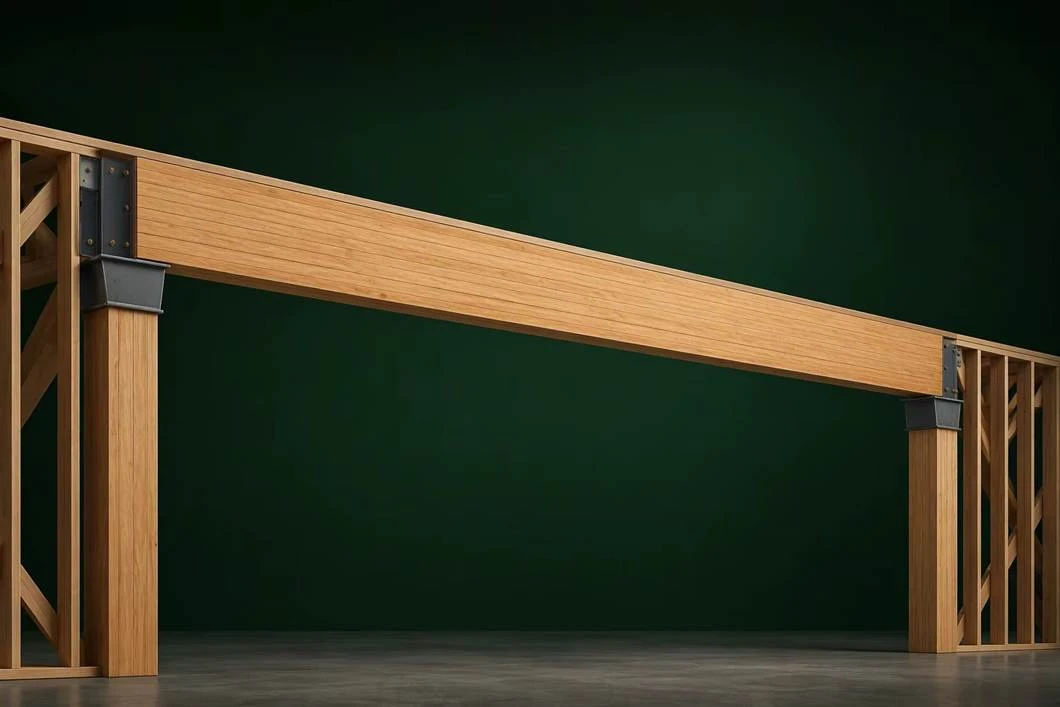
LVL's engine ered consistency allowsitto span significantlyfartherthan a comparable solid timber section, often eliminating the ne edfor anintermediate support column.
Dimensional Stability: The Quieter but Costly Difference
Strength numbers get the attention, but dimensional stability is often what actually causes problems on a job site months after installation. Solid timber is prone to movement as moisture content changes after milling - shrinking, warping, twisting, and in more severe cases splitting, particularly if the material wasn't fully dried before installation (SXH Wood - LVL Beams vs Solid Wood).
LVL's layered construction, with each veneer's grain running the same direction but bonded under controlled manufacturing conditions, produces a product that is considerably more dimensionally stable - resisting the twisting, warping, and shrinkage that affects solid timber as ambient moisture conditions change (Oklahoma State University Extension - LVL as a Construction Material). That said, LVL isn't entirely immune to moisture-related issues - improper storage and exposure to prolonged wet conditions before installation can still cause defects, which is a detail worth flagging to any buyer assuming LVL requires no jobsite handling care at all.
For framing that will be enclosed or finished shortly after installation - where post-installation warping could telegraph through drywall, flooring, or trim - this stability difference has real downstream cost implications, independent of the beam's load rating.
Cost: What Buyers Are Actually Comparing
Cost comparisons between LVL and solid timber vary significantly by region, beam size, and current lumber market conditions, but general pricing patterns are informative for budgeting purposes. As of early 2026, standard LVL beams in common residential sizes were running in the range of 2.80to3.40 per lineal foot for 1-3/4" x 9-1/2" sections, with broader industry
estimates placing LVL beam costs generally between 3and12 per linear foot depending on size, grade, and regional availability
(BuilderMuse - Lumber Prices 2026; LVL-Beam.com - LVL Beams Cost). Solid dimensional lumber pricing tracks separately with broader commodity lumber markets, which have shown continued volatility through 2026 (Trading Economics - Lumber Price Chart).
The more useful comparison for procurement isn't simply price-per-foot - it's total installed cost for a given span and load requirement. A solid timber solution that requires an additional intermediate support column to achieve the same span as a single LVL beam may end up costing more once labor, foundation work, and design constraints are factored in, even if the raw material itself is cheaper per foot.
Matching the Material to the Application
For most buyers, this decision resolves cleanly once the actual structural requirement is defined:
Choose LVL for long-span headers, multi-story load-bearing applications, heavy point loads, projects requiring predictable engineering values for structural calculations, and any application where post-installation warping or shrinkage would be costly to remedy.
Choose solid timber for shorter residential spans, light-frame construction where budget is the primary driver, markets with strong local timber supply and lower LVL availability, and applications where the natural aesthetic of solid wood is a design requirement rather than a purely structural one.
As a manufacturer producing structural LVL, including Construction LVL Beam and LVL Door Frame/Core product lines alongside a broader range of engineered wood panels, WADA GROUP supplies contractors and building material distributors with LVL manufactured to consistent grading standards, backed by an in-house quality inspection team monitoring batch-to-batch consistency - the same consistency that makes LVL the preferred choice over solid timber for demanding structural applications in the first place.
Conclusion: Let the Span and Load Requirement Decide
There's no universally "better" material between LVL and solid timber - there's only the material that's better suited to a specific structural requirement. LVL wins decisively on strength consistency, span capability, and dimensional stability, which is why it dominates long-span and heavy-load applications in modern framing. Solid timber remains a legitimate, often more economical choice for shorter spans and light-frame construction where its natural variability doesn't threaten the structural design.
If you're specifying beams for an upcoming construction project and want technical documentation or grading specifications for structural LVL, contact our team to request current product specifications and bulk pricing for your framing requirements.
Sources Referenced
Murphy Plywood - LVL Product Report, ASTM D5456
Mississippi State University - Ultra Stiff Wood Composite: A Comparison of Strength Properties TT Plywood - Impressive Load-Bearing Strength of LVL
Fuqing Muye - LVL vs Dimensional Lumber Strength
SXH Wood - LVL Beams vs Solid Wood: Which One Should You Choose?
Oklahoma State University Extension - Laminated Veneer Lumber (LVL) as a Construction Material BuilderMuse - Lumber Prices 2026: Forecast, Tariff Impact & Buying Guide
LVL-Beam.com - LVL Beams Cost: Understanding Pricing for Quality Lumber
Trading Economics - Lumber Price Chart