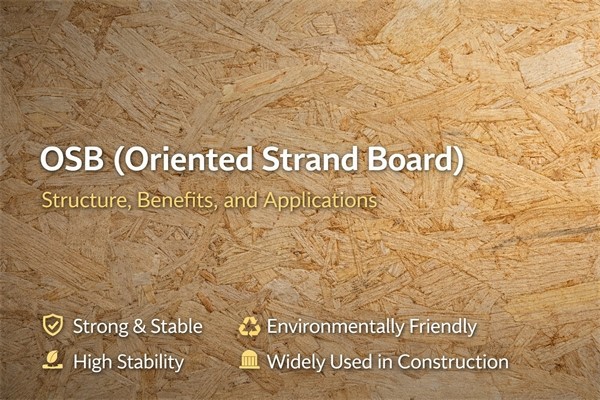
What is OSB?
Oriented Strand Board (OSB) is an engineered wood product made from small-diameter logs, thinnings, and wood cores. The strands are processed, dried, bonded with adhesives, and compressed under high temperature and pressure.
Its key feature is the cross-oriented layering structure - outer layers aligned lengthwise and inner layers crosswise - providing enhanced structural stability.
Structural Features & Advantages
OSB offers several performance benefits due to its engineered structure:
1. High Stability
Cross-layered design reduces expansion and deformation, ensuring dimensional stability.
2. Strong Mechanical Performance
High bending strength and load-bearing capacity.
3. Good Workability
Can be cut, drilled, nailed, and processed similarly to natural wood.
4. Moisture Resistance
Dense structure provides improved resistance to moisture and wear.
Environmental Performance
OSB is manufactured using eco-friendly adhesives and complies with European standards such as EN300.
Key environmental benefits include:
Low formaldehyde emissions
Comparable to natural wood in sustainability
Meets green building material standards
OSB is increasingly recognized as a sustainable alternative in modern construction.
Applications
OSB is widely used in:
Structural construction (walls, roofs, flooring)
Interior decoration (partitions, base panels)
Furniture manufacturing
Packaging and industrial uses
It is also used for acoustic panels and decorative applications.
Market Outlook
Driven by sustainability trends, OSB demand continues to grow:
Increasing share in engineered wood markets
Replacement for plywood and traditional boards
Widely used in green buildings and modern interiors
Conclusion
OSB stands out as a key material in modern construction due to its strength, stability, and environmental performance.
As demand for sustainable materials grows, OSB will play an increasingly important role in global markets.