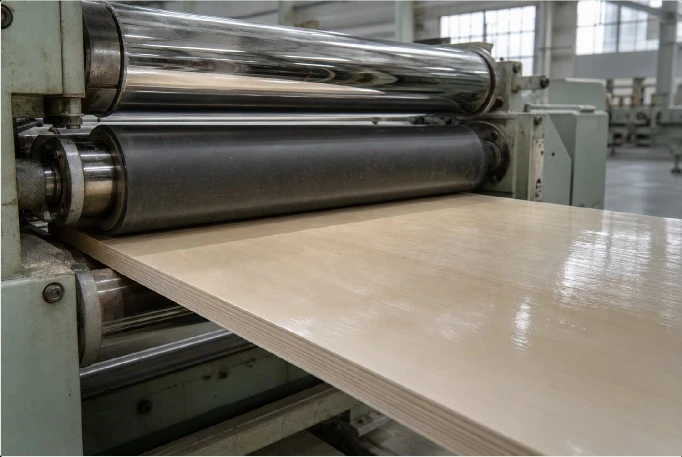
Figure 1: Roller glue spreading. Spread rate follows the adhesive type, veneer thickness and substrate absorbency; consistency across the panel matters more than the number itself.
The starting point: what the previous stage hands over
Part I of this series set out three conditions a substrate must meet before veneering: moisture content generally below 14%, thickness deviation within ±0.10 mm after sanding, and surface defects filled and conditioned for five to six days.
Those figures are not formalities. They define how much room the rest of the line has to work with.
Uneven thickness distributes press pressure unevenly. Thick areas are over-pressed - the density profile collapses and the substrate telegraphs through the veneer - while thin areas are under-pressed, leaving a bond that never achieved continuous contact.
High, uneven moisture traps steam during pressing and produces blisters. A spread of two or three percentage points across one panel means different shrinkage after the press, and the panel bows on its own.
Filler that has not dried softens and compresses under heat, so the face sinks locally after pressing. Sanding does not recover it.
The veneering line can absorb small variations in spread. It cannot absorb a thickness tolerance or a moisture distribution it was never given. In practice, the first quality control point of a veneering shop sits in the previous department.
Adhesive: choose by service condition, not by price
Matching the adhesive to where the panel will live
|
Service condition |
Typical adhesive |
Note |
|
Interior, dry (furniture, door cores, display cases) |
Urea-formaldehyde (UF) |
Lowest cost, most established process; not for prolonged humid exposure |
|
Interior with occasional humidity (kitchen and bathroom surroundings, coastal markets) |
Melamine-urea-formaldehyde (MUF) |
Better water resistance than UF, at higher cost and tighter process control |
|
Exterior or continuously humid |
Phenol-formaldehyde (PF) |
Best water resistance, but dark in colour, may stain pale veneers, and needs longer press time |
|
Special requirements (no-added-formaldehyde, fast cure) |
Isocyanate systems (EPI/PUR) |
Requires separate evaluation of process window and cost; not a standard configuration |
Engineered veneer - typically 0.10–0.50 mm thick - differs from natural thin veneer in one way that matters here: it is reconstituted and denser, with lower permeability. Wetting therefore depends more heavily on surface condition and open time. An adhesive that behaves well on natural veneer can leave patchy unbonded areas on engineered veneer without any change in the glue itself.
Mix by weight, not by eye
Most mixing failures are not wrong formulations. They are approximations.
Hardener dosage. Too little leaves the glue line under-cured, tacky and poor in water resistance. Too much thickens the mix early, shortens working life and spreads unevenly.
Extender. Wheat flour or wood flour adjusts viscosity, reduces cost and limits bleed-through. Too much makes the glue line brittle and weak; too little allows bleed-through.
Water. Used to adjust viscosity, but water temperature and quality also shift the cure rate.
Pot life. Shorter in summer, longer in winter - the same formulation does not have the same usable window across seasons. Mix a batch sized to what the shift will actually consume.
The record is simple: resin batch number, hardener dosage, water addition, mixing time, discard time. During an audit, this sheet tells you more than the equipment nameplate.
Two habits worth dropping
"Thicker glue is stronger glue." A mix that is too thick spreads unevenly, and the edges are the first place it fails - a defect that only becomes visible after trimming, when the batch is already finished.
"Thinner glue saves money." Under-spreading creates a starved glue line that often passes a casual factory check and opens up later at the customer's machining stage, where responsibility becomes much harder to establish.
Glue spreading: evenness, edge coverage, open time
Roller spreaders are the standard configuration. Spread rate is set by adhesive type, veneer thickness and substrate absorbency, and should follow the adhesive supplier's technical data sheet. No universal figure is given here, because a number detached from a specific adhesive and veneer misleads more than it helps.
Three things can be judged directly on the line:
Evenness across the panel - a continuous film with no streaks, skips or ridges.
Coverage to the edges - the outer 20–30 mm must carry adhesive. This is the most frequently neglected check and the most consequential: after trimming, an under-glued edge is exposed as an open glue line, which is where delamination and moisture ingress begin.
No abnormal bleed-through after lay-up - dense bleed spots indicate excess spread or a mix that is too thin.
The consequences are not symmetrical:
|
Condition |
Immediate effect |
Later effect |
|
Under-spread |
Discontinuous film |
Starved glue line, edge delamination; rarely visible at dispatch, appears at downstream machining |
|
Over-spread |
Bleed-through, higher mat moisture |
Sunken veneer, surface contamination, longer press time, later shrinkage and surface waviness |
Open assembly time - the interval between spreading and loading the press - must be fixed, not left to the operator. Too long and the film skins over, weakening the interface; too short and the adhesive has not penetrated enough. This belongs in the work instruction.
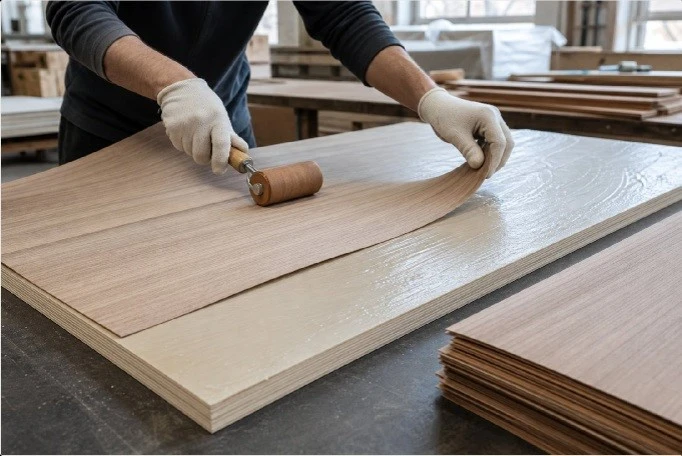
Figure 2: Lay-up. Joint gaps, grain direction and foreign matter are all settled at this stage; none of them can be corrected after pressing.
Lay-up: symmetry matters more than appearance
Balanced construction
Wood is anisotropic: it swells and shrinks differently along and across the grain. If the two faces of a panel are not equivalent - 0.30 mm on one side and 0.20 mm on the other, or veneer on one face and nothing on the
other - the two sides develop different stresses and the panel cups toward the stronger side. This is the most common source of bowing in thin veneered panels, and it is a structural problem, not an adhesive problem.
Balanced construction is unglamorous: same species, same thickness, same moisture content, same grain
direction on both faces. Where full symmetry is impossible - single-sided veneering, for example - the order and drawing should say so explicitly, and the flatness risk should be accepted knowingly rather than discovered later.
Joints and grainJoints. Gap width is controlled to an agreed value; overlapping edges are not acceptable; the joint itself needs adhesive, otherwise it becomes a capillary path for moisture.
Grain. Grain runs in the same direction across a batch, which is what makes colour transition between adjacent components look natural. Engineered veneer is colour-stable within a batch, but different batches can differ, so compare before mixing batches on one project.
Foreign matter. Sand, dried glue, chips. Under a veneer sheet, each becomes a bump or a press mark that cannot be repaired - only planed off, which means losing the panel.
One detail that gets skipped
Do not handle a spread face with bare hands, and do not leave laid-up panels open in a dusty area. Grease and dust both cause the bond to fail at the interface, and that failure is invisible in the finished panel - it shows up only in a peel test or in service.
Hot pressing: four variables that cannot be adjusted one at a time
Temperature, moisture, pressure and time interact. This is not a new finding: research published by the U.S. Forest Products Laboratory with ASME in the 1930s quantified the effect of each on bond strength, and the conclusion still holds as basic practice - raising one variable does not generally compensate for a
deficiency in another.
A frequently cited pressing condition for UF-bonded plywood is 1.4 MPa specific pressure at 120 °C for 4 minutes. Those figures apply to plywood and cannot be transferred directly to MDF-substrate veneered
panels, where the pressure window is different. Actual settings follow the adhesive supplier's data sheet and the specific build-up.
Temperature
Too low leaves the adhesive under-cured. Early strength can look normal while water resistance and durability fall away - a defect that inspection rarely catches. Too high discolours the veneer, particularly pale engineered veneer, crushes the substrate surface and causes sticking to the platen.
Platen temperature uniformity deserves its own check, measured at several points rather than read from the panel instrument. Platen edges run cooler as a rule, so panels at the edge of the load are inherently less well cured.
Pressure
Too little pressure leaves the film without continuous contact; the interface contains microscopic voids, and strength is low and highly variable. Too much collapses the density profile of the MDF - dense faces over a
looser core - producing soft edges, reduced final thickness and substrate telegraphing through the veneer. A panel pressed too hard also sands through to the substrate sooner.
The load must sit entirely within the platens. Anything overhanging the edge is effectively unpressed, and this is the most common avoidable error on a shop floor.
Time
Press time is not a fixed number of seconds; it is the time required for the glue line at the centre of the buildup to reach cure temperature and hold it. Thicker build-ups, more openings per cycle and thicker cauls all
lengthen heat penetration. Running a thin-panel cycle on a thick panel under-cures the core.
Moisture
Veneer that is too wet seals water at the interface during pressing, producing blisters during the cycle or shortly after. Veneer that is too dry absorbs adhesive and starves the line. Published work on plywood indicates that veneer in the 4–12% range works well with resin systems, but that range is a plywood
experience, not a specification - each veneering line should establish its own window against its adhesive and drying conditions.
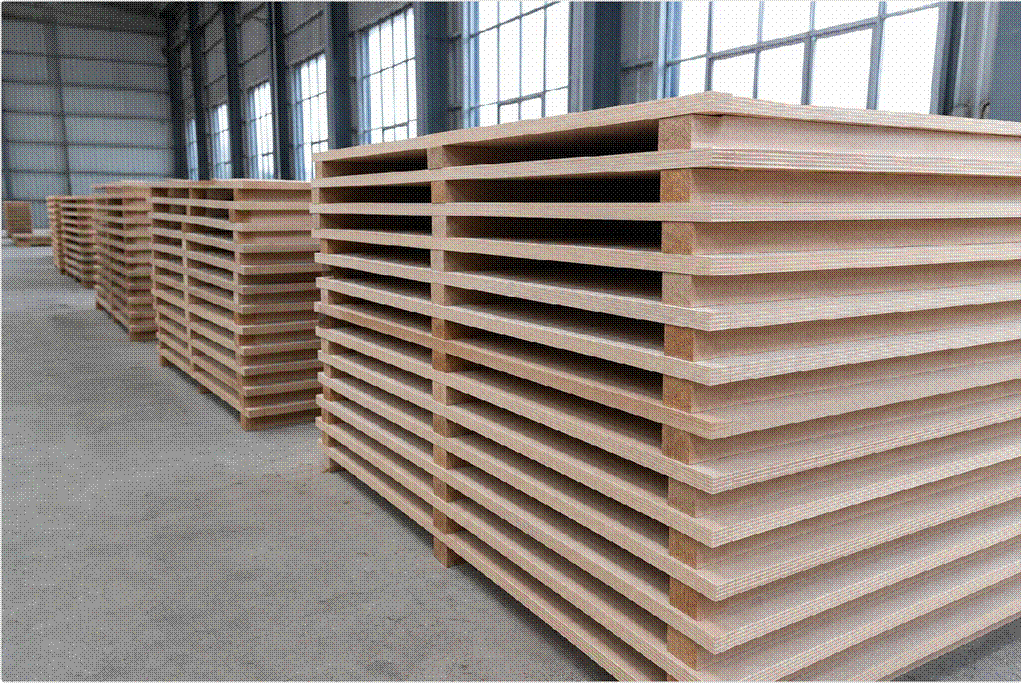
Figure 3: Cooling and stacking. Panels leave the press hot, with moisture still redistributing; trimming or sanding at this point leaves dimensions and flatness to move afterwards.
After the press: cooling and stacking
This stage is often dropped when capacity is tight, and it decides whether a panel deforms at the customer's site.
A panel leaving the press is hot, with the adhesive still setting and moisture unevenly distributed. Trim or sand it immediately and the panel shrinks afterwards - dimensions and flatness both change. Stack flat, with bearer strips aligned vertically, and apply weight where the specification calls for it. Panels leaned on edge or stacked across misaligned bearers will cool into a bow. Bring the stack close to shop temperature before the next
operation. The instruction is easy to write and the first one to be sacrificed to output.
Trimming, inspection and packing
Trimming. All four edges are cut square, with machining allowance as agreed with the customer. The exposed edge is the inspection focus: is the glue line continuous, is there any starved section, is the veneer chipped.
Inspection.
|
Item |
Method / basis |
Note |
|
Bond quality |
Agreed test method and limit |
For plywood substrates, European buyers commonly cite EN 314-2 bonding classes; there is no parallel unified class for MDF substrates, so the method must be agreed in the order |
|
Surface quality |
Visual inspection under raking light |
Defect types and acceptance criteria are set out in our companion article on veneered panel defects |
|
Thickness and bow |
Measured at agreed points |
Bow is measured with the panel resting free on a flat surface, not clamped |
|
Moisture content |
EN 322 method |
Dispatch and arrival values differ, particularly after ocean freight |
Packing. Corner protection, moisture barrier, bearers, and securing inside the container. Condensation and moisture uptake in transit are a frequent cause of arrival disputes, and many of those disputes are finally attributed to "product quality" when the cause was packing and transport conditions.
Process control at a glance
|
Stage |
Control point |
Typical sign of drift |
Record |
|
Substrate handover |
Moisture content, sanded thickness deviation, filler dryness |
Blisters, telegraphing, local sinking |
Substrate inspection sheet |
|
Adhesive mixing |
Hardener dosage, viscosity, pot life |
Brittle or tacky glue line, uneven spread |
Mixing log (batch / dosage / time) |
|
Spreading |
Evenness, edge coverage, spread rate |
Starved line, edge delamination, bleed-through |
Spreader settings log |
|
Lay-up |
Symmetry, joints, foreign matter |
Bow, joint cracking, press marks |
First-piece approval |
|
Pressing |
Temperature, pressure, time, load alignment |
Under-cure, telegraphing, thickness loss |
Press cycle record |
|
Cooling and stacking |
Flat stacking, bearer alignment, cooling time |
Secondary distortion, out-of-flat panels |
Stacking compliance check |
|
Trimming and inspection |
Edge glue line, surface, thickness |
Chipping, undetected delamination |
Dispatch inspection report |
|
Packing |
Corner protection, moisture barrier, securing |
Arrival moisture damage, edge damage |
Packing check sheet |
Conclusion
Veneer quality is rarely decided by whether the adhesive is good. It is a chain: substrate thickness and
moisture, adhesive ratio and working life, spread evenness and edge coverage, lay-up symmetry, the four press variables, and cooling after the press. Each link tolerates only a limited deviation, and no later stage recovers a link that has already failed.
For buyers this means two practical things. During a factory audit, process records are more reliable evidence than samples. In a contract, writing down the symmetrical build-up, the bond test method and limit, and how bow will be measured costs far less than resolving the dispute later.
About WADA GROUP
WADA GROUP was established in 2010 and operates three factories in Xuzhou and Lianyungang, supported by overseas branches in Japan and Singapore. The company maintains an 18-person quality inspection team and an independent laboratory, holds EUDR, EPA, JAS, JIS, CARB P2 (EPA) and FSC certifications, and exports 100% of its output to more than 50 countries.
References
Forest Products Laboratory / ASME, Dry Film Gluing in Plywood Manufacture - systematic quantification of heat, moisture, pressure and time effects on bond strength (1930s).
Pressing conditions for UF-bonded plywood (1.4 MPa specific pressure, 120 °C, 4 minutes) as reported in published studies including Properties of Plywood Produced with Urea-Formaldehyde Adhesive.
EN 314-2, Plywood - Bonding quality - Part 2: Requirements.
EN 322, Wood-based panels - Determination of moisture content.
WADA GROUP, Technology Wood Veneering Process (Part I) - substrate selection, sanding and surface treatment.
WADA GROUP, Veneered Panel Defects and Acceptance Criteria: A Practical Inspection Guide.
Editorial note
Pressing figures quoted here come from published research on plywood and are used to explain how the variables interact; they are not a process commitment for any specific product. Actual veneering parameters should follow the adhesive supplier's technical data sheet and the equipment in use, and should be verified at first-piece approval. The images in this article are AI-generated illustrations without text or brand marks; they explain process concepts and are not product or process evidence.