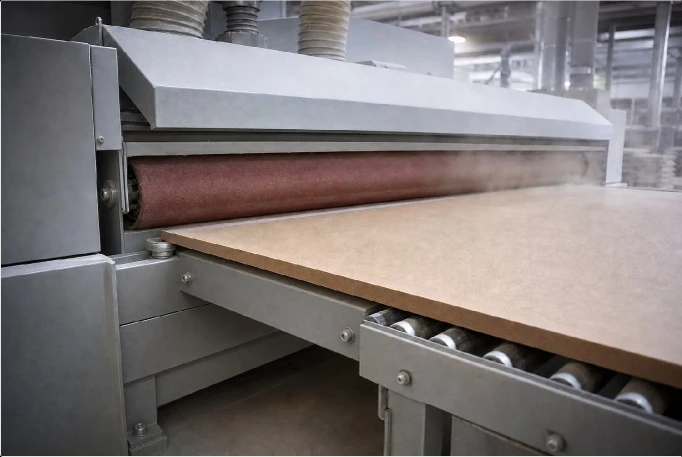
Figure 1: Double-sided calibration sanding. The press delivers a panel slightly thicker than the finished target; sanding removes a layer from each face and brings the thickness spread under control.
Three different things called "thickness"
Purchasing conversations tend to merge three separate items:
Nominal thickness. 18 mm is a specification name, not a measured commitment. It says which size class the panel belongs to, not how thick a particular panel is.
Thickness tolerance. The permitted deviation around nominal. This is the only binding figure, and it has to come from a standard or from the contract.
Measured thickness. One number, taken at one position, with one instrument, in one condition.
Disputes sit almost entirely between items 3 and 2: the buyer treats a measurement as the whole truth, the supplier treats the tolerance as a complete defence, and neither side ever agreed how to measure, where to measure, or how much deviation was acceptable.
Calibration: thickness is sanded into existence
MDF is not pressed to its final thickness in one step. The sequence runs as follows:
The mat enters the press and is consolidated to a target slightly above finished thickness. The press controls density and the density profile, not the final dimension.
The panel is cooled and edge-trimmed.
It passes a double-sided calibration sander - coarse heads followed by finer heads - which removes a layer from each face, brings thickness close to nominal and flattens the surface.
Two consequences follow, and both are widely misread:
Sanding changes thickness, deliberately. If pressed thickness varies across a batch, sanding removes the high points but cannot add material to the thin ones. The post-sanding distribution is the product of the pressed distribution and the sanding allowance.
Sanding removes the densest layer. MDF has a density profile: dense faces over a looser core. How
much is sanded away directly affects what happens next - over-sanded panels have a more open surface, higher absorbency and a greater tendency to telegraph through a veneer; under-sanded panels stay
uneven in thickness and flatness.
This is also why sanded and unsanded (raw) MDF are different products, not the same board at two prices.
Raw board is sold at press thickness with a wider tolerance and suits buyers who will machine their own
thickness. Sanded board is sold at nominal thickness with a tighter tolerance and goes directly into veneering, coating or edge banding.
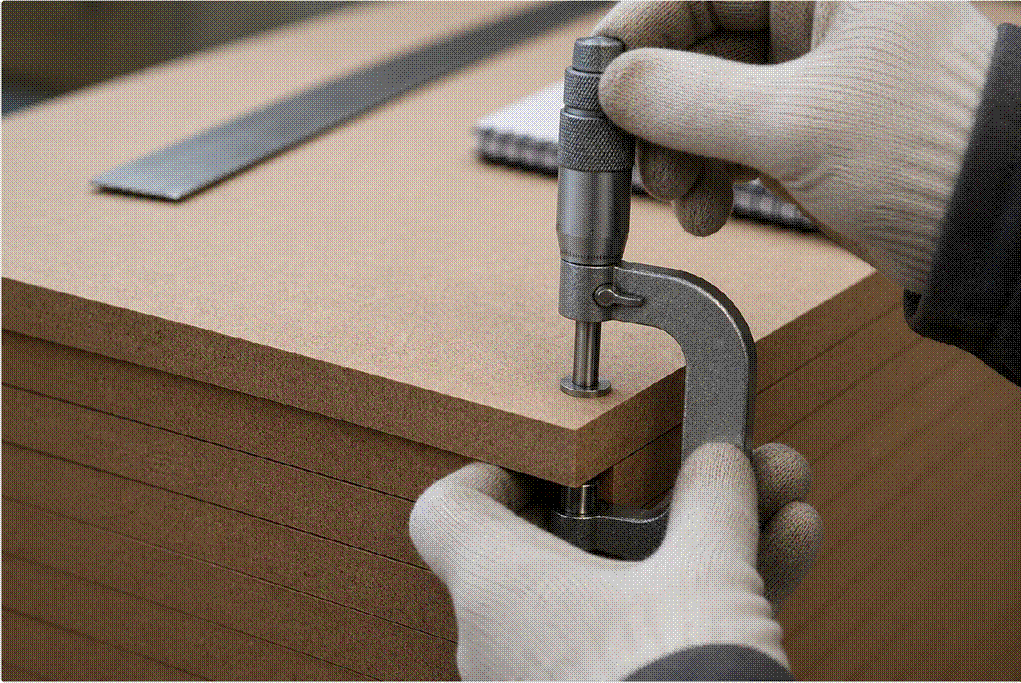
Figure 2: Thickness measurement. Instrument, measuring position and moisture condition all change the reading; unless all three are standardised, readings cannot be compared.
Why one stack gives different readings
|
Cause |
Symptom |
Explanation |
|
Density profile |
Face reads slightly thicker than near the core |
MDF keeps a dense-face, looser-core gradient even after sanding |
|
Measuring position |
Edge versus centre, corner versus middle |
Edges cool faster and receive pressure differently; edges usually read thinner or tighter |
|
Instrument and contact force |
Caliper, micrometer and tape give different results in that order |
A contact instrument compresses the surface; different spring force, different reading. A tape measure is not a thickness instrument at all |
|
Moisture content |
The whole panel thickens after absorbing moisture, edges first |
Thickness moves with moisture content - precisely what EN 317 measures |
|
Panel temperature |
Panels straight off the line or recently in sun read high |
A panel that has not reached thermal equilibrium is still moving dimensionally |
|
Cause |
Symptom |
Explanation |
|
Stack load |
Bottom and top of a stack differ |
Sustained compression produces a small, permanent thickness loss |
The practical conclusion is blunt: a single reading means nothing. What carries information is a set of readings - same instrument, same measuring points, same condition - reduced to a mean and a range.
Moisture makes panels thicker, and part of it stays
MDF gains thickness when it absorbs moisture. That is inherent material behaviour, not a defect. EN 317 determines swelling in thickness after immersion; EN 322 determines moisture content. The more common field version is moisture uptake in ocean transit:
Temperature swings inside a container cause condensation, and the outer panels and edges absorb it first.
On opening, edges read thick and faces show local waviness, which looks like a thickness failure but is swelling.
Part of that swelling recovers on drying; part of it, especially at the edges, does not.
So arrival measurement has a precondition: let the panels stabilise in the shop before measuring.
Measured straight out of the container, you are measuring transport condition, not product condition.
For veneer producers the effect is amplified, because finished panel thickness is substrate plus two veneer faces plus glue lines. A substrate varying by ±0.3 mm carries that variation straight into the finished panel, and unequal veneer thickness on the two faces adds a bowing risk on top - the mechanism described in our
companion article on the veneering process.
The five items an order must state
Most thickness disputes can be removed at the ordering stage. Leave out any one of these and it will be argued about later.
|
Item |
What to write |
What happens without it |
|
1. Nominal thickness and permitted deviation |
For example "18 mm, deviation as agreed" |
Each side applies its own default and rejects the other's |
|
2. Measurement standard and method |
Cite EN 324-1 (determination of dimensions) or an agreed method, and name the instrument type |
Caliper and micrometer give two answers and neither can be adjudicated |
|
3. Measuring condition |
State the moisture or conditioning condition at measurement (EN 322 for moisture content) |
Measuring on arrival and measuring after conditioning give different results |
|
Item |
What to write |
What happens without it |
|
4. Sampling and decision rule |
How many panels, how many points per panel, mean or maximum, and what happens on failure |
One out-of-tolerance panel means rejecting a batch, or a batch fails with nobody accountable |
|
5. Treatment of deviation |
Price adjustment, replacement, or acceptance |
The dispute can only be settled by negotiation |
Item 4 is the one most often skipped. A mean-based rule and a maximum-point rule are two very different acceptance regimes - the first is lenient to the supplier and risky for the buyer, the second the reverse. Writing the rule down is more useful than arguing whether a particular panel is compliant.
Measuring on arrival: a workable sequence
Fix the instrument. One contact instrument type (micrometer or dial caliper) for the whole batch, model recorded.
Fix the measuring points. Define positions on the panel - avoiding the outermost edge zone - and measure the same positions on every panel.
Condition first. Let panels stabilise in the shop environment; do not measure straight out of the container.
Record three numbers. Mean, maximum and minimum. A single figure cannot tell you whether the batch runs thin systematically or contains isolated outliers.
Keep evidence. Photograph the measuring position and the instrument reading, and file it with the batch number.
Judge against the agreed rule. Apply item 4 from the order as written, not as reinterpreted on the day.
Two more numbers that matter as much as thickness
For veneering, coating or edge banding, thickness alone is not enough:
Density (EN 323). Standard MDF commonly sits in the 700–800 kg/m³ range; high-density fibreboard
(HDF) is generally above 800 kg/m³. Density drives screw holding, the quality of a routed edge, and how readily a substrate telegraphs through a face veneer. Our standard MDF is specified at 720–750 kg/m³.
Thickness swelling (EN 317). This sets dimensional stability after moisture exposure. For kitchens and
bathrooms, specify a moisture-resistant grade in the order; the difference between MDF.H and MDF.HLS is covered in our companion article on moisture-resistant MDF.
Thickness is about fitting and jointing flush. Density and swelling are about lasting. Agreeing all three is what actually specifies a panel.
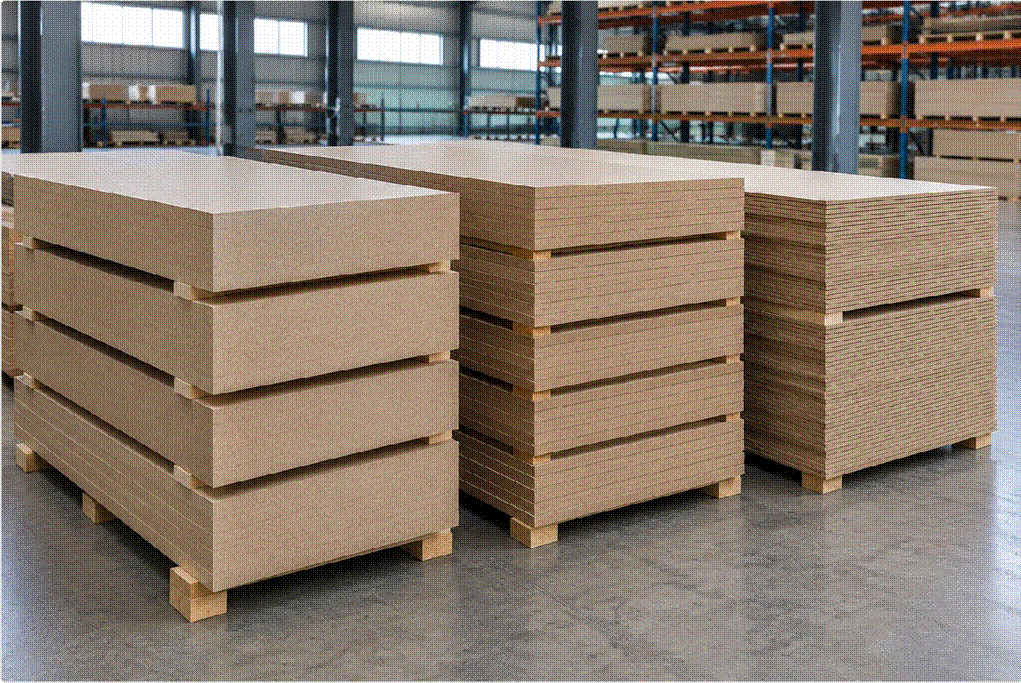
Figure 3: Separate stacks by specification. Nominal thickness is only a size class; the binding requirements are the tolerance, the measurement method and the decision rule agreed in the order.
Conclusion
An 18 mm nominal MDF panel that does not measure 18.00 mm is not an anomaly. It is the normal outcome of how the board is pressed, sanded and conditioned. The figure that needs managing is not the difference itself but three questions around it:
Is the difference inside the range both sides agreed?
Are both sides measuring the same way?
What happens when it is outside the range?
Put those three into the purchase order and thickness stops being a dispute and becomes a verifiable technical clause.
About WADA GROUP
WADA GROUP was established in 2010 and operates three factories in Xuzhou and Lianyungang, supported by overseas branches in Japan and Singapore. The MDF range covers 3–25 mm thickness in 1220×2440 mm, with standard density of 720–750 kg/m³; grade, thickness and surface finish can be confirmed against project
requirements. The company maintains an 18-person quality inspection team and an independent laboratory, holds EUDR, EPA, JAS, JIS, CARB P2 (EPA) and FSC certifications, and exports 100% of its output to more than 50 countries.
References
EN 324-1, Wood-based panels - Determination of dimensions of boards - Part 1: Determination of thickness, width and length.
EN 322, Wood-based panels - Determination of moisture content.
EN 323, Wood-based panels - Determination of density.
EN 317, Particleboards and fibreboards - Determination of swelling in thickness after immersion in water.
EN 622-5, Fibreboards - Specifications - Part 5: Requirements for dry process boards (MDF).
WADA GROUP, Moisture-Resistant MDF: Choosing Between MDF.H and MDF.HLS, and How to Specify and Verify It.
WADA GROUP, Technology Wood Veneering Process (Part II): Glue Spreading, Lay-Up and Hot Pressing.
Editorial note
No specific tolerance value is given here, because permitted deviation depends on the thickness class, the sanding configuration and what the two parties agree; a figure quoted without those conditions gets misused as a universal standard. Acceptance should follow the purchase order and the applicable standard. The images are AI-generated illustrations without text or brand marks; the measuring and stacking scenes illustrate the sequence and are not operating instructions.