How to Vet a Chinese Wood Panel Supplier: A 10-Point Checklist
Use this checklist for plywood, MDF and particleboard enquiries, adapting technical requirements to the intended application and destination. Keep an evidence file for each candidate and record unresolved questions before paying a deposit. The ten checks below support a purchasing decision; they do not certify any supplier or guarantee a defect-free shipment.
Establish who will supply the order
1. Verify the legal entity and payment identity
Request the supplier's Chinese legal name, business license and Unified Social Credit Code. Cross-check registration information through China's National Enterprise Credit Information Publicity System, linked by the State Administration for Market Regulation.
Compare the registered entity with the quotation, contract and proposed beneficiary. An export agent or affiliated company may legitimately be involved, but the relationship needs documentation. Independently confirm changed bank instructions through an established contact channel before transferring funds. Pause if: the seller will not identify the contracting entity or explain an unrelated beneficiary.
2. Establish the actual manufacturing arrangement
Ask whether the seller manufactures, trades or combines both roles. Identify the production site and any outsourced pressing, laminating, machining or finishing relevant to your order. A trader is not automatically unsuitable; unexplained responsibility is the problem.
Use a live walkthrough or scoped independent visit to connect the named site with equipment, production records and quality-control personnel. Ask for a realistic production schedule rather than accepting a capacity slogan. Keep: the factory address, order owner, subcontracting arrangement and inspection-access agreement. A registration record alone does not demonstrate these capabilities.
Define the panel and its compliance evidence
3. Turn the product name into a written specification
"Commercial plywood" or "premium MDF" is not an acceptance standard. Specify panel type, dimensions, thickness tolerance, construction, surface requirements and intended use. For plywood, identify face/back grading rules, core species or composition, permitted defects and bonding requirements; for other panels, use the relevant product specification.
Keep appearance, bond durability and load-bearing performance separate. APA's plywood guidance distinguishes these selection criteria. Pause if: a supplier treats matching face-grade letters as proof of structural capacity. Attach the agreed specification to the order and require approval before substitutions.
4. Match regulatory documents to the destination and product
Prepare a destination-specific compliance list before requesting certificates. For the United States, EPA identifies regulated hardwood plywood, MDF and particleboard under TSCA Title VI, while listing exclusions, including qualifying structural products. A generic "wood panel" description cannot settle applicability.
For covered products, check the relevant certification, labeling and recordkeeping evidence, including the recognized third-party certifier where required. Do not treat an emissions-grade slogan as equivalent documentation. Keep: a clear link between the offered product, actual producer and applicable compliance documents. Resolve uncertainty with qualified compliance support before shipment.
5. Verify certification claims beyond the logo
If the purchase requires FSC-certified material, use FSC's official public certificate tools to check the organization and certificate details, including the product information available there. Do not rely only on a scanned certificate or a website badge.
Ask the seller to explain which supplied products are covered and how the agreed claim will appear in transaction documents. Confirm ambiguous scope directly with the certification body. Treat responsible-sourcing claims separately from emissions or structural performance. Pause if: the certificate belongs to an unexplained third party or does not support the product claim being offered.

Test quality and repeatability before scaling up
6. Read the test report, not just the pass statement
Request the complete report, then check the issuer, report identifier, test date, method, sample description and measured results against the ordered product. Clarify who selected the sample and whether it represents a production batch or a supplier-submitted specimen.
Verify suspicious or material details directly with the issuer using independently sourced contact information. Different thicknesses, constructions or finishes may need different supporting evidence. Keep: a report-to-product mapping and any explained limitations. A genuine report for an unrelated board is still inadequate evidence for your order.
7. Approve representative samples and a practical trial
Define who selects samples and preserve agreed reference pieces with identification. Evaluate appearance and dimensions against the specification, then trial the intended operation-such as machining, coating or assembly-where relevant. A small showroom coupon should not substitute for checks that require full-size panels.
Record acceptance criteria before testing, not after a disappointing result. Consider a controlled pilot order before increasing volume, and document both satisfactory results and required corrections. Pause if: the supplier offers only handpicked display samples but will not support an agreed production-sampling process.
8. Check batch traceability and corrective action
Ask how a delivered bundle can be traced to its production and inspection records. Review how the supplier separates nonconforming material, authorizes rework and documents changes to core materials, glue systems or finishing processes.
Request a redacted example of a closed quality complaint and the corrective action taken, without demanding another customer's confidential information. Keep: the batch-identification method and an agreed change-notification procedure. A trial demonstrates one delivery; repeat orders still need checks that connect the approved specification to the material actually produced and released.
Make delivery and acceptance enforceable
9. Agree packing, inspection and shipment release
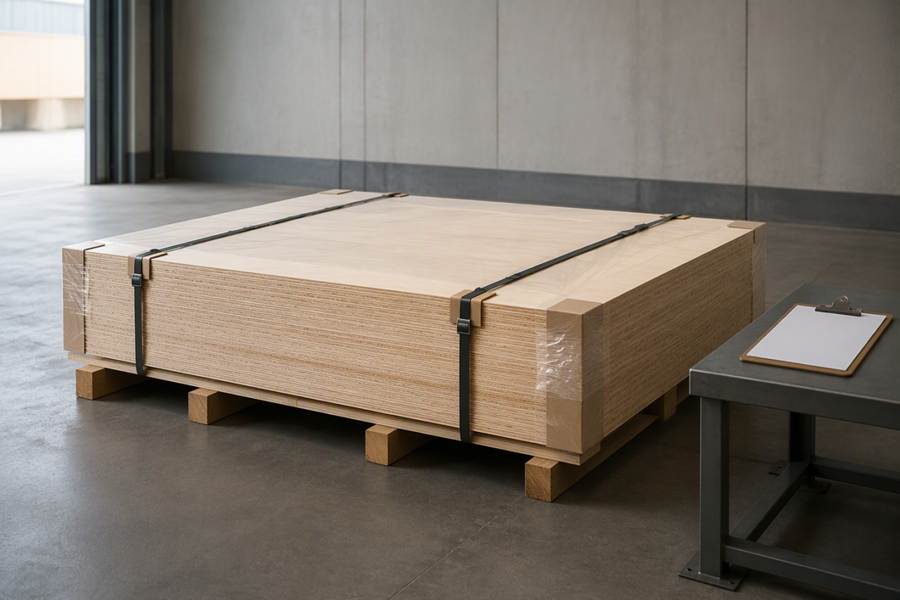
Write down bundle protection, support, moisture-management arrangements, identification and loading requirements appropriate to the product and route. Agree inspection timing, lot definition, sampling method, defect categories and acceptance rules before production ends; there is no universal sample percentage suitable for every order.
Give the inspector access to the actual shipment and define how findings trigger correction, reinspection or a hold. Keep: inspection records and loading evidence linked to shipment identification. Photographs document what was visible; they cannot establish internal bonding or emissions compliance on their own.
10. Put commercial responsibilities and remedies in writing
Compare prices only after aligning specifications, quantities, packing, named delivery terms and inspection costs. The contract should identify the parties, payment milestones, delivery schedule, permitted changes, claim procedure and remedies for nonconforming goods. Define who pays for reinspection, replacement or other agreed corrective work.
Use qualified advice for governing law and dispute-resolution provisions. Before increasing order value, close unresolved findings and review pilot performance. Decision rule: do not let a low price offset an unexplained identity mismatch, unsupported compliance claim or refusal of agreed inspection.
A strong supplier file connects all ten checks rather than treating documents as isolated badges. Send shortlisted suppliers the same specification and evidence request, resolve critical gaps, and approve an initial order only when responsibilities and acceptance conditions are clear.
Sources and scope
[1] SAMR registration guidance and official enterprise-information portal link; National Enterprise Credit Information Publicity System.
[2] APA - Plywood selection and specification.
[3] EPA - Formaldehyde standards: regulated-stakeholder FAQs, updated April 1, 2026.
[4] FSC - Official public certificate-search guidance.
Sources checked September 23, 2026. Some reference pages do not state publication dates; confirm applicable requirements for the destination, product and shipment. Uncited inspection and contracting steps are editorial risk-management recommendations, not universal legal requirements. This article is not a supplier audit or legal opinion. All images are AI illustrations and must retain that disclosure when reused.