This distinction matters for roof decking, wall sheathing, flooring, packaging platforms and other projects where panels may encounter construction humidity or intermittent wetting. Selecting OSB/3 can provide a more suitable starting specification for a humid service condition, but it does not remove the need for drainage, covering, ventilation, edge protection or engineering checks.
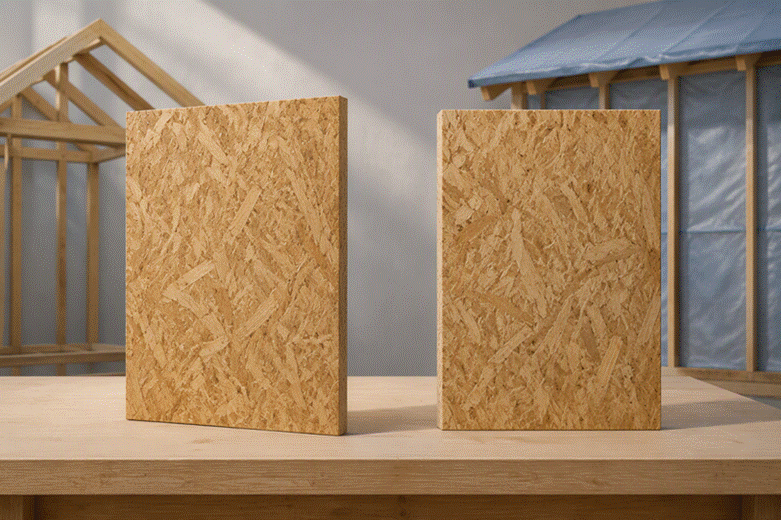
1. What is the practical difference between OSB/2 and OSB/3?
The short answer is the combination of load-bearing use and moisture condition. EN 300 establishes definitions, classifications and requirements for oriented strand boards. Product descriptions based on the standard commonly identify OSB/2 with load-bearing applications in dry conditions and OSB/3 with load-bearing applications in humid conditions. The category therefore gives a buyer an important service-condition signal, but it does not replace the full technical specification.
The word "humid" should not be read as "submerged," "permanently exposed to rain" or "immune to swelling." Wood-based panels respond to changes in moisture. The panel's adhesive system, strand orientation, density profile, thickness, edge condition, support spacing and installation details all influence performance. A board that is suitable for a protected humid building assembly can still be damaged by repeated soaking or by being left uncovered on site.
A quotation should therefore state the grade, applicable standard, thickness, dimensions, tolerances, declared performance data and intended application. Ask for the manufacturer's marking and data sheet for the exact product rather than relying on a catalogue sentence copied between different product ranges.
2. When is OSB/2 the right choice?
OSB/2 is the logical starting point when the panel is load-bearing and the service environment is expected to remain dry. Examples may include protected interior wall, floor or roof components where the building envelope is complete or where the panel will not experience sustained moisture during normal service. The final use still needs to be checked against the project's structural design, national building rules and the manufacturer's declared performance.
OSB/2 can also be commercially attractive when a project does not need the additional humid-condition classification. However, a lower purchase price is not a saving if the panel is exposed to moisture beyond its intended service condition. Swelling, edge movement, loss of fit and rework can outweigh the original material difference. Storage is part of the specification: keep panels flat, elevated from ground moisture, protected from direct rain and allowed to acclimatize according to the supplier's instructions.
Do not select OSB/2 solely because the finished room will eventually be dry. Consider the whole construction sequence. If the panel will be installed before the roof or weather-resistive layer is complete, document how long it may be exposed and how it will be protected. Temporary exposure should be controlled rather than used as an assumption that changes the grade.
3. When is OSB/3 the better specification?
OSB/3 is generally the more appropriate starting point when the panel must carry loads in a humid service condition. This may include protected roof, wall or floor assemblies where ambient humidity is higher or where the building envelope can create a humid environment. The selection is not based on the word "outdoor" alone; it is based on the defined service condition, the structural requirement and the assembly's protection strategy.
OSB/3 does not mean the board can remain exposed to weather indefinitely. The face and especially the edges still need protection from repeated wetting, standing water and uncontrolled drying. Panels should be installed with the specified support, fasteners, spacing and joints. Cut edges and penetrations may require treatment or sealing under the project specification. Where exposure will be prolonged or direct, continuous rain is expected, the designer should review whether another material or a different envelope strategy is required.
Also separate product classification from design capacity. BSI's description of BS EN 300:2006 notes that the values in the standard relate to product properties and are not characteristic values for design calculations. Structural design uses the appropriate test methods, characteristic values and design data referenced by the applicable standards. OSB/3 is therefore not a substitute for a structural calculation.
4. How should you classify the moisture exposure?
"Moisture-prone project" is too broad for a purchase order. Divide the exposure into at least three stages:
Normal service condition: the humidity the panel is expected to experience after the building is completed.
Construction-stage exposure: short-term contact with rain, condensation or wet trades before the envelope is closed.
Abnormal or continuous exposure: repeated rain, leaks, standing water, ground contact, wash-down or an assembly that cannot dry.
OSB/3 may be a better specification for the first category when the design falls within a humid condition. It does not automatically solve the second or third category. The site team still needs covered storage, raised stacking, prompt installation, temporary membranes, drainage and inspection after wetting. If the board has swollen, delaminated, lost edge integrity or no longer meets the required geometry, it should not be accepted simply because it carries an OSB/3 marking.
Ask the designer or engineer to define the exposure in project language: "protected humid assembly with temporary weather protection" is more useful than "water-resistant board." Then make the supplier quote the same condition. This prevents a buyer from comparing OSB/2 and OSB/3 on price while silently comparing different service assumptions.
5. What should buyers verify before ordering?
Use this short checklist for an OSB purchase:
Grade and standard: OSB/2 or OSB/3, with the applicable edition of EN 300 or the market's required equivalent.
Design evidence: declared strength and stiffness information, design values or an engineer-approved calculation for the intended use.
Panel identity: manufacturer, product line, thickness, dimensions, marking and batch traceability.
Moisture controls: storage, edge treatment, temporary covering, joint gaps and installation sequence.
Inspection criteria: thickness, dimensions, flatness, visible defects, edge condition and packaging damage.
Substitution rule: no change from OSB/2 to OSB/3, or from one manufacturer's grade to another, without written approval.
EN 300 itself points users toward other standards for structural testing and characteristic design values. That is why a sales sheet saying "strong and moisture resistant" is not enough for a structural project. Request documents that cover the exact product and check whether the test or certificate applies to the panel being quoted.

6. Final decision: choose the service condition, then control the water
Choose OSB/2 when the panel is load-bearing and the defined service condition is dry, with the construction sequence controlled so that temporary exposure does not undermine that specification. Choose OSB/3 when the panel is load-bearing and the defined service condition is humid, provided the assembly, design data and protection details support the choice.
For both grades, the purchasing decision should connect four items: the grade marking, the project's service condition, the structural design and the moisture-management plan. If one of those items is missing, the grade alone cannot predict the outcome.
The most reliable specification does not say simply "OSB/3 for outdoor use." It states the board grade, standard, thickness, design requirement, exposure condition, storage and installation controls, inspection criteria and approval process for substitutions. That level of detail helps contractors, distributors and importers compare like with like-and avoid paying for a grade that is unsuitable, or using a suitable grade in an assembly that still leaves the panel unprotected.
Sources and editorial boundaries
[1] BSI Knowledge - BS EN 300:2006, Oriented strand boards: definitions, classification and specifications.
[2] Buildwise - EN 300 overview.
[3] Example OSB/2 technical data sheet.pdf). This is a product data sheet used only to illustrate the dry-condition classification; it is not a universal specification for every OSB/2 product.
This article is educational content, not structural, building-code or engineering advice. Confirm the current standard edition, national requirements, design values and manufacturer documentation before purchase or installation. The three images are AI-generated concepts and are not product certification, installation instructions or test evidence.